
Keep Your Bobcat Loader from taking a Snow Day
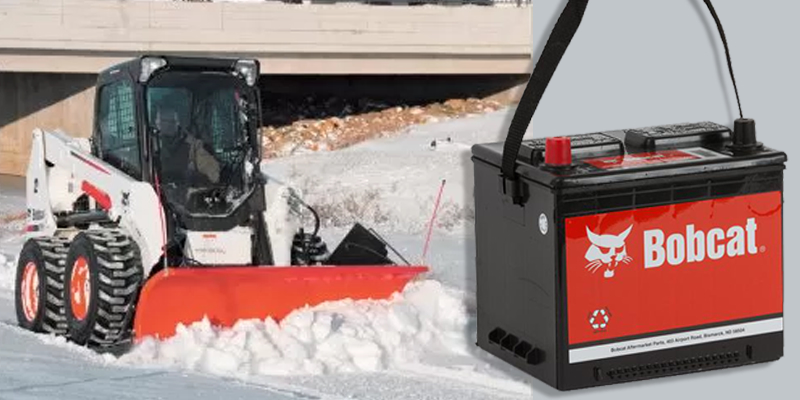
Before unleashing your Bobcat Loader on the snow, follow this quick seasonal maintenance checklist. It will keep your Bobcat running efficiently all season.
When your projects call for winter work, contractors rely on skid-steer loaders and compact track loaders to keep their operation running. Skid-steer and compact track loaders are tough enough to easily transition to the cold. They have the versatility to move from general construction and landscaping work to snow removal with ease.
Change Fluids with the Season
There’s nothing like an insulated thermos of hot coffee to get you through a brisk winter’s day. If your compact loader could talk, it would tell you the same. Check your Bobcat compact loader maintenance schedule and fill up with the proper cold-weather engine oil, coolant, hydraulic oil and fuel to help minimize maintenance problems.
Engine Oil
You’ll want an engine oil viscosity that matches the temp outside. For better cold-weather starting and lubrication, use 5W-40 synthetic oil, which typically protects down to 40o below zero. If you’re expecting a milder winter, 10W-30 is a common factory fill that performs down to minus 20° F.
Engine Coolant
Antifreeze is just as important for your compact loader as it is for your car or truck. Test it and top it off before work begins.
Hydraulic Oil
Synthetic blends provide good cold-weather fluidity. Since you live here in the Hudson Valley, you’ll want a high-performance hydraulic lubricant. They’re custom blended to give your compact loader peak flow in subzero temps.
Diesel Fuel
In extreme cold, diesel fuel will gel. Normally, a No. 2 grade diesel fuel may be fine, but you will want to switch to an alternative diesel fuel if an extended cold snap is coming your way. If the temperature will be above 15°F, you can use 100% Grade 2-D fuel. For temperatures down to minus 5°F, use 50% Grade 2-D fuel and 50% Grade 1-D fuel. Switch to 100% Grade 1-D fuel for temperatures below minus 5°F.
The Operation & Maintenance Manual has recommended maintenance schedules and oil change intervals, fluids and fuels specific to your machine and cold weather conditions. Double-check your loader manual before you change fluids to match the season. Let the team at Summit Bobcat help you choose the right fluids and fuels.
Fill-up Cold Loader Tires
Remember that experiment from science class where the balloon shrinks from the cold? The same thing happens to your tires. When the temperature drops, so does the tire pressure. Cold weather also makes the rubber stiffer. If you notice your tires sagging after a dip in temp, fill them up to capacity. Repair any leaks suffered in the busy season during your regular maintenance schedule. A small leak or nail in the tire is easy to put off in warmer weather – you may only have to fill your tire once a week. In winter, once a week can turn into once a day. You’ll eliminate a lot of wasted time and ensure that low tire pressure doesn’t drain your pushing and lifting power throughout the day.
Charge the Loader’s Battery
It takes a little longer to get going in the mornings when it’s cold – for both you and your compact loader. You layer up and crank the heat to power through, only to find that your skid-steer or compact track loader can’t even power up. Freezing temps force your compact loader’s battery to crank twice as hard to turn over, deliver fuel to the engine and start up. Before the next project or snowfall, run a load test and check wires and connections for wear or corrosion. Even a small defect can result in a loss of cranking amps, leaving you with a dead battery, freezing your project.
Check the Loader Cab’s Comfort Features
Freezing temps are no time to test your toughness. Don’t let your skid-steer or compact track loader leave the garage after its scheduled maintenance without checking everything that keeps the cab warm. Inspect the door and window seals to make sure heat won’t escape. Test that the heating, defogging and defrosting systems are all working, and get the heated seat turned on and warmed up. If any of those systems go out on the job, it will make for a long, uncomfortable day for you or another operator.